Best Chronograph Watches in 2026
The 8 best chronograph watches in 2026 ranked by value, mechanical interest, and wearability. From the IWC Rattrapante at €15K to the Lange Datograph at €90K, with 3 available from our inventory.
Written by Pavel Vlachkov with AI assistance.
The best chronograph watch in 2026 is the IWC Pilot’s Double Chronograph Rattrapante Top Gun Ceratanium, a rattrapante (split-seconds) chronograph in an all-black Ceratanium case that retails for around €14,700. For collectors on a tighter budget, the Zenith Chronomaster Sport at roughly €8,000 on the secondary market delivers the legendary El Primero movement in a package that competes directly with watches costing three times as much.
We tested, handled, and compared dozens of chronographs across price points. Below are the eight that earned their spot, ranked by value, mechanical interest, and how much we actually enjoyed wearing them.
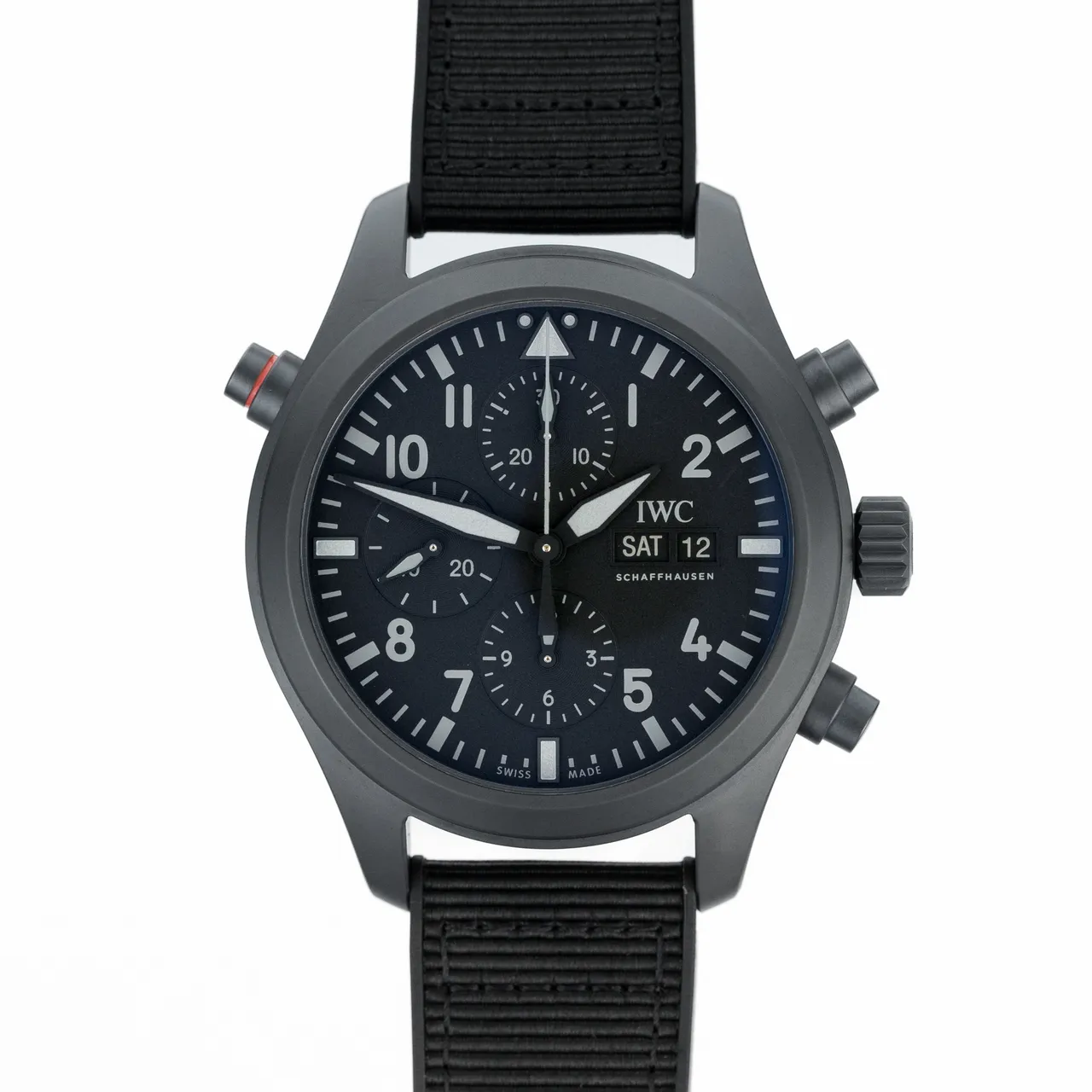
1. IWC Pilot’s Double Chronograph Rattrapante Top Gun Ceratanium
| Specification | Detail |
|---|---|
| Case | 44mm Ceratanium (ceramic + titanium alloy) |
| Movement | Calibre 79230, automatic rattrapante, 44h power reserve |
| Water resistance | 60m |
| Price range | €15,000–19,000 pre-owned |
A rattrapante chronograph is one of the most mechanically complex watch functions you can buy. IWC’s version uses an additional chronograph hand that can be stopped independently, letting you time two events simultaneously. The Ceratanium case is scratch-resistant like ceramic but tough like titanium, a material IWC developed in-house and debuted in 2019.
The all-black look works. No contrasting sub-dials, no color accents, just pure stealth. At 44mm it wears large, but the lightweight Ceratanium (around 30% lighter than steel) keeps it from feeling like a brick. According to Monochrome Watches, this remains "relatively reasonable for an automatic rattrapante chronograph in an innovative material."
Pros: Rattrapante complication at mid-range pricing, proprietary case material, military-inspired design
Cons: 44mm is too big for smaller wrists, only 60m water resistance, date window is hard to read
Where to buy: Available at ChronoTimepieces
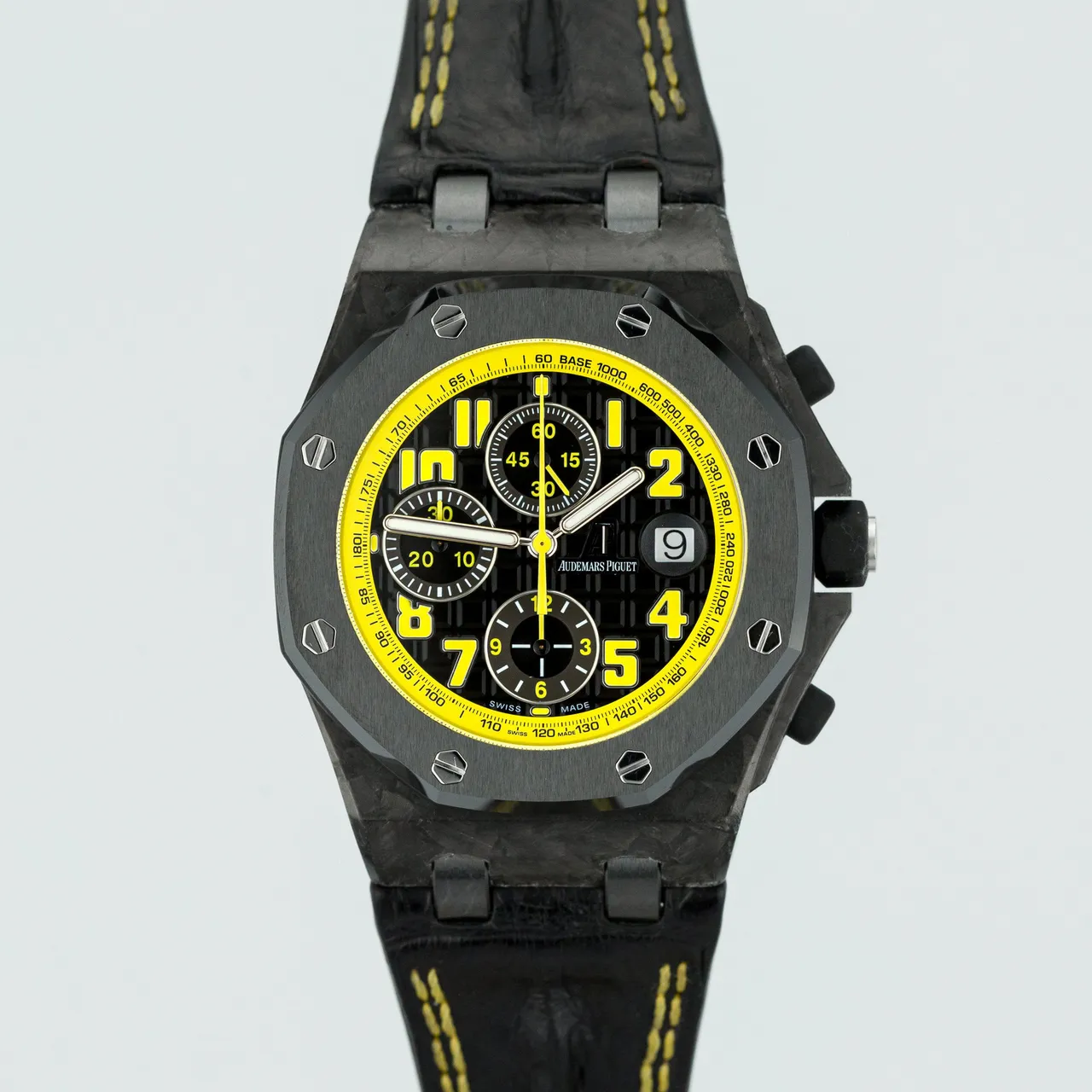
2. Audemars Piguet Royal Oak Offshore "Bumble Bee"
| Specification | Detail |
|---|---|
| Case | 42mm forged carbon with black ceramic bezel |
| Movement | Calibre 3126/3840, automatic chronograph, ~55h power reserve |
| Water resistance | 100m |
| Price range | €16,000–27,000 pre-owned |
The "Bumble Bee" nickname comes from the black-and-yellow color scheme, and it’s one of the most recognizable Royal Oak Offshore variants ever made. The forged carbon case gives each watch a unique marbled pattern since no two pieces of forged carbon look identical.
AP priced the Bumble Bee at $35,800 retail. Pre-owned examples on Chrono24 currently trade between $16,600 and $26,800 depending on condition and box/papers. That is a serious discount from retail, and AP’s return to Watches & Wonders 2026 (happening in two weeks) could shift demand upward.
Pros: Unique case material, strong brand recognition, holds value well relative to retail
Cons: 42mm forged carbon wears thicker than you’d expect, rubber strap can deteriorate over time
Where to buy: Available at ChronoTimepieces
3. Omega Speedmaster "First Omega in Space" Pulsometer
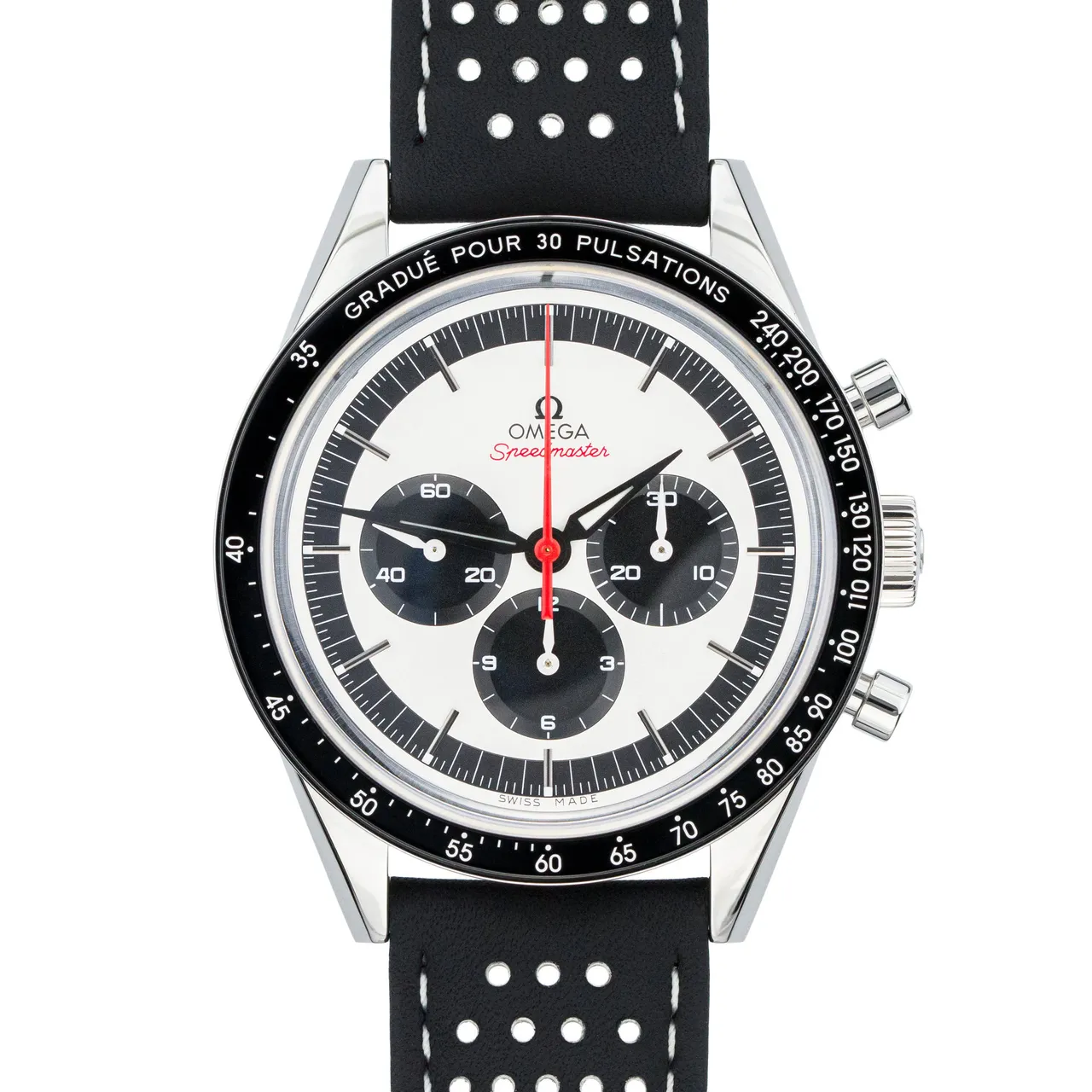
| Specification | Detail |
|---|---|
| Case | 39.7mm stainless steel |
| Movement | Calibre 3861, manual-winding, METAS-certified, 50h power reserve |
| Water resistance | 50m |
| Price range | €5,500–8,500 pre-owned |
On October 3, 1962, Wally Schirra wore his CK2998 Speedmaster aboard the Sigma 7 Mercury mission, making it the first Omega in space. This modern tribute pairs a grey/blue dial with a pulsometer scale, a feature originally designed for doctors to measure heart rates.
At 39.7mm, it’s one of the few modern chronographs that doesn’t require a large wrist. Retail sits at $8,900 on bracelet. Pre-owned examples from the earlier reference trade below $5,500, making it one of the most affordable ways into a historically significant Speedmaster.
Pros: Sub-40mm size, space heritage, pulsometer scale adds character, METAS-certified
Cons: Manual winding only, limited water resistance, sapphire crystal back (purists prefer hesalite)
Where to buy: Available at ChronoTimepieces
4. Rolex Cosmograph Daytona 126500LN
| Specification | Detail |
|---|---|
| Case | 40mm Oystersteel with ceramic bezel |
| Movement | Calibre 4131, automatic, 72h power reserve |
| Water resistance | 100m |
| Price range | €25,000–35,000+ pre-owned |
Everyone knows the Daytona. The 126500LN introduced the ceramic bezel and Rolex’s newest chronograph calibre with a 72-hour power reserve, a jump from the previous 116500LN’s 50 hours. Secondary market prices peaked around $45,000 in 2022, according to WatchCharts, then corrected to the $28,000–35,000 range by early 2026.
Is it the best chronograph movement? Probably not. A. Lange & Söhne would have something to say about that. But for sheer name recognition, liquidity on the secondary market, and the ability to wear it with literally anything, the Daytona is hard to argue against.
Pros: Best resale value in the segment, 72h power reserve, fits small wrists at 40mm
Cons: Virtually impossible to buy at retail, secondary market premium is steep, ubiquity
Where to buy: Rolex authorized dealers (good luck) or secondary market platforms like Chrono24
5. Zenith Chronomaster Sport
| Specification | Detail |
|---|---|
| Case | 41mm stainless steel with ceramic bezel |
| Movement | El Primero 3600, automatic, 1/10th of a second, 60h power reserve |
| Water resistance | 100m |
| Price range | €7,000–9,000 pre-owned |
Zenith’s El Primero was the world’s first automatic chronograph movement when it launched in 1969, beating Seiko’s 6139 by a few months (both camps still argue about it). The modern Chronomaster Sport runs at 36,000 vibrations per hour, five beats per second, giving it a 1/10th-of-a-second measurement capability that most Swiss chronographs can’t match.
Pre-owned prices sit around $8,000. According to a Chrono24 Magazine analysis from February 2026, the Zenith "is available for around $8,000, while the visually similar Rolex Daytona commands dizzying market prices." If you care about what’s inside more than what’s on the dial, Zenith wins this argument.
Pros: Legendary movement, 1/10th-second precision, fraction of Daytona pricing
Cons: Lower brand recognition outside enthusiast circles, ceramic bezel insert can chip
Where to buy: Zenith boutiques or pre-owned via Chrono24
6. Breitling Navitimer B01 Chronograph 41
| Specification | Detail |
|---|---|
| Case | 41mm stainless steel |
| Movement | Breitling Calibre B01, automatic, 70h power reserve |
| Water resistance | 30m |
| Price range | €5,500–7,500 pre-owned |
The Navitimer has been in continuous production since 1952 and still carries the circular slide rule bezel that pilots used for fuel calculations, speed, and distance conversions. The B01 is Breitling’s in-house movement, a proper column-wheel chronograph with a 70-hour power reserve.
At 41mm, Breitling finally addressed the old complaint that Navitimers wore too large. Pre-owned B01 examples start around $5,500 on secondary platforms. That is a lot of watch for the money, especially compared to the Daytona. The dial is busy, though. If you don’t love busy dials, look elsewhere.
Pros: In-house movement, 70h power reserve, 41mm size option, slide rule actually works
Cons: 30m water resistance is low, busy dial divides opinion, Breitling’s resale lags competitors
Where to buy: Breitling boutiques and authorized dealers, or Chrono24
7. Tudor Black Bay Chrono
| Specification | Detail |
|---|---|
| Case | 41mm stainless steel |
| Movement | MT5813 (Breitling B01 base), automatic, 70h power reserve |
| Water resistance | 200m |
| Price range | €4,000–5,500 pre-owned |
Tudor uses a version of Breitling’s B01 calibre, rebranded as the MT5813. Same architecture, same reliability, different badge. At 200m water resistance, the Black Bay Chrono is the toughest daily-wear chronograph on this list.
Pre-owned prices hover around €4,000–5,500. That is under half the retail price of a Zenith Chronomaster Sport and about one-seventh of a Daytona. Tudor doesn’t have the same status, obviously. But if you want a well-built chronograph you can actually swim with and not worry about, this is it.
Pros: 200m water resistance, 70h power reserve, competitive pricing, Breitling-based movement
Cons: Tudor resale is soft, design polarizes (panda dial or nothing), 41mm but wears thick
Where to buy: Tudor authorized dealers or Tudor’s pre-owned program
8. A. Lange & Söhne Datograph Up/Down
| Specification | Detail |
|---|---|
| Case | 41mm 18k white gold or rose gold |
| Movement | Calibre L951.6, manual-winding, flyback, 60h power reserve |
| Water resistance | 30m |
| Price range | €65,000–90,000 pre-owned |
If money isn’t the constraint, this is where the conversation ends. The Datograph’s movement uses a column-wheel flyback chronograph with Lange’s signature three-quarter plate in German silver, hand-engraved balance cock, and the oversized "Outsize Date" display that started the big-date trend in 1994. Every component is finished by hand. Twice, actually, because Lange assembles each watch, takes it apart, and reassembles it.
This isn’t a daily wearer. It’s 41mm of white gold, which is heavy. The 30m water resistance means you take it off to wash your hands (figuratively). But as a pure expression of chronograph watchmaking, nothing on this list comes close.
Pros: Arguably the finest chronograph movement ever made, Lange finishing, flyback function
Cons: €65,000+ price, fragile for daily wear, 30m WR, manual-winding only
Where to buy: A. Lange & Söhne boutiques or Chrono24
Quick comparison
| Watch | Case size | Movement | Power reserve | Water res. | Pre-owned price |
|---|---|---|---|---|---|
| IWC Rattrapante Top Gun | 44mm | Auto rattrapante | 44h | 60m | €15,000–19,000 |
| AP ROO Bumble Bee | 42mm | Auto chronograph | ~55h | 100m | €16,000–27,000 |
| Omega FOIS Pulsometer | 39.7mm | Manual chronograph | 50h | 50m | €5,500–8,500 |
| Rolex Daytona 126500LN | 40mm | Auto chronograph | 72h | 100m | €25,000–35,000 |
| Zenith Chronomaster Sport | 41mm | Auto chronograph | 60h | 100m | €7,000–9,000 |
| Breitling Navitimer B01 41 | 41mm | Auto chronograph | 70h | 30m | €5,500–7,500 |
| Tudor Black Bay Chrono | 41mm | Auto chronograph | 70h | 200m | €4,000–5,500 |
| A. Lange Datograph Up/Down | 41mm | Manual flyback | 60h | 30m | €65,000–90,000 |
How we chose these watches
We looked at three things: mechanical interest (is the movement worth talking about?), wearing experience (does it actually feel good on the wrist?), and value proposition (are you getting what you’re paying for?).
We excluded quartz chronographs entirely. Nothing against them, but if you’re spending four figures or more on a chronograph, the movement matters. We also excluded watches that are essentially unobtainable, like the Patek Philippe 5270P or anything from F.P. Journe’s current production, since recommending what you can’t buy isn’t useful.
Every watch on this list is available on the secondary market right now. We checked.
What is a chronograph watch?
A chronograph is a watch with a built-in stopwatch function, operated by pushers on the side of the case. The word comes from the Greek "chronos" (time) and "grapho" (to write). Most chronographs use two or three sub-dials to display elapsed seconds, minutes, and sometimes hours. The complication has been around since 1816, when Louis Moinet built the first known chronograph for tracking astronomical objects.
What’s the difference between a chronograph and a chronometer?
A chronograph is a type of complication (stopwatch function). A chronometer is a precision certification from COSC (Controle Officiel Suisse des Chronometres) indicating the movement keeps time within -4/+6 seconds per day. A watch can be both, one, or neither. The Rolex Daytona 126500LN on this list is both a chronograph and a Superlative Chronometer (Rolex’s own standard of -2/+2 seconds per day).
Are pre-owned chronographs a good investment?
Some are. Rolex Daytonas have appreciated 40–60% over the past five years according to WatchCharts data, though the market corrected significantly in 2023–2024. AP Royal Oak Offshore models hold value well relative to retail. Most other chronographs depreciate like any luxury good. Buy what you want to wear. If it appreciates, that’s a bonus.
What is a rattrapante (split-seconds) chronograph?
A rattrapante chronograph has two chronograph seconds hands stacked on top of each other. You can stop one independently to record an intermediate time while the other keeps running. It requires a significantly more complex movement, which is why rattrapante watches (like the IWC at #1 on this list) command premium pricing. Fewer than a dozen brands currently produce them.
Is a flyback chronograph worth the premium?
A flyback lets you reset and restart the chronograph with a single pusher press instead of the usual stop-reset-start sequence. It was originally designed for pilots who needed to time sequential navigation legs quickly. In daily life, the convenience is marginal. In mechanical terms, the additional mechanism is impressive. Whether the €2,000–5,000 premium is "worth it" depends on how much you value the engineering.